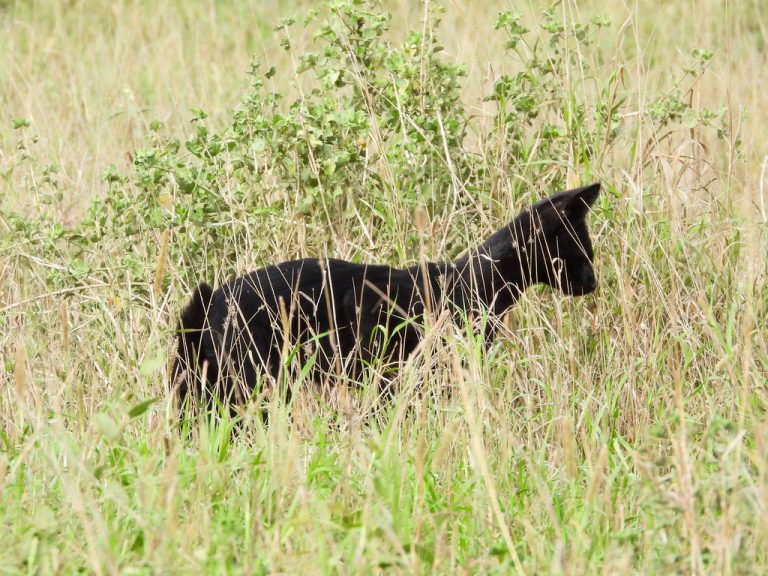
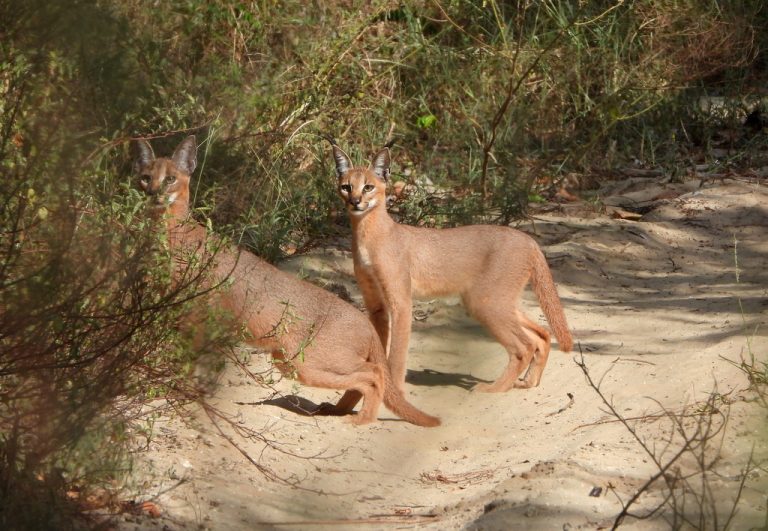
The Seven Wild Cats of Namibia – from Desert Lions to the Secretive Black-footed Cat
Few countries can match the diversity of wild cats found in Namibia. From the dune fields of the Namib Desert to the mopane woodlands of the northeast, this sparsely populated southern African nation supports seven species of native felids, including some of Africa’s rarest and most elusive predators. Namibia is particularly important for cat conservation because much of its wildlife survives outside national parks on communal conservancies and private farmland, creating both opportunities and conflicts for long-term survival.
The seven species are the lion, leopard, cheetah, caracal, serval, African wildcat, and black-footed cat. Several of these populations are globally significant. Namibia holds one of the largest remaining free-ranging populations of cheetahs anywhere in the world and is internationally recognized as a stronghold for desert-adapted lions and leopards.
- 1. Lion – Southern Lion
- 2. Leopard – African Leopard
- 3. Cheetah – Southern and Eastern African Cheetah
- 4. Caracal - Southern and Eastern Caracal
- 5. Serval - Southern Serval
- 6. African Wildcat - Southern African Wildcat
- 7. Black-footed Cat
- Namibia’s Importance for Wild Cat Conservation
- Best Places in Namibia to See Wild Cats
- Key Sources

1. Lion – Southern Lion
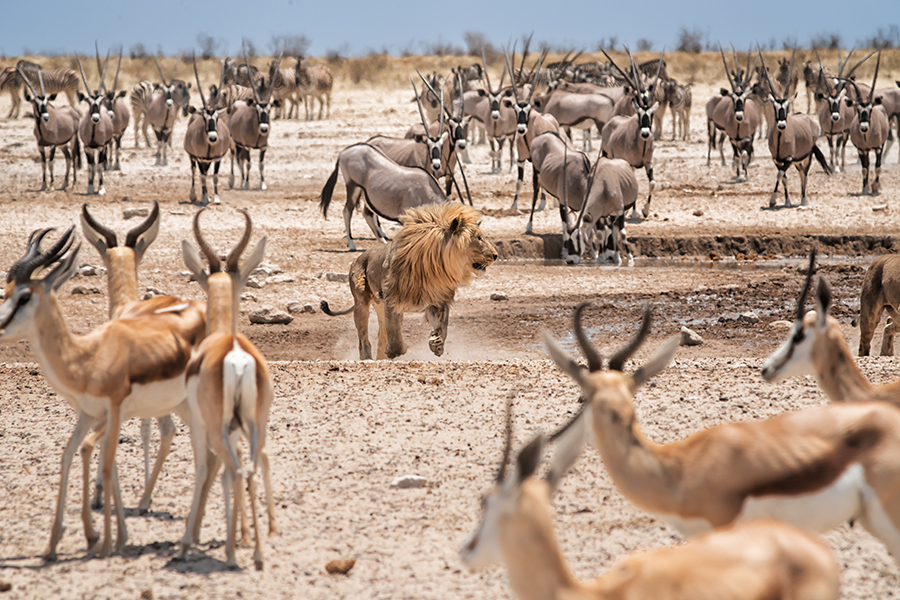
Namibia’s lions belong to the subspecies Panthera leo melanochaita, often referred to as the Southern Lion. The country’s most famous populations occur in and around Etosha National Park and the arid northwest regions of Kunene, where the legendary “desert lions” roam.
Globally, lions are listed as Vulnerable on the IUCN Red List. Namibia’s national carnivore Red Data Book also classifies lions as Vulnerable. The Namibian population is relatively small compared with East African lion strongholds, with roughly 800 lions estimated nationally according to recent Namibian assessments. (Cheetah Conservation Fund)
The desert-adapted lions of northwest Namibia are among the most remarkable big cats in Africa. These lions survive in one of the driest environments inhabited by lions anywhere on Earth. They travel enormous distances between river systems such as the Hoanib and Hoarusib and prey on springbok, oryx, and occasionally livestock.
Long-term research by organizations including the Desert Lion Conservation project has documented how these lions have adapted behaviorally to extreme desert conditions. However, human-wildlife conflict remains a major threat, particularly outside protected areas where lions sometimes kill cattle, goats, or donkeys.

2. Leopard – African Leopard
Leopards are probably the most widespread large cat in Namibia and occur across much of the country, from mountains and savannas to desert-edge habitats. The Namibian leopard belongs to the subspecies Panthera pardus pardus.
Globally, the leopard is listed as Vulnerable by the IUCN, although some regional populations are in severe decline. Namibia’s national Red Data Book also categorizes the species as Vulnerable. Estimates suggest Namibia may support one of southern Africa’s more stable leopard populations, with fewer than 12,000 animals estimated nationally. (Cheetah Conservation Fund)
Leopards are famously adaptable and are found even near settlements and farmland. Research in Namibia has shown that many leopards survive outside national parks, particularly on commercial farmland and communal conservancies. Camera-trap studies and GPS collaring projects have revealed that male leopards can maintain extremely large territories in arid landscapes. (ScienceDirect)
Despite their adaptability, persecution by livestock farmers remains a challenge. Leopards are also vulnerable to snaring and retaliatory killings. Namibia nevertheless remains one of the better countries in Africa for observing truly wild leopards.
3. Cheetah – Southern and Eastern African Cheetah
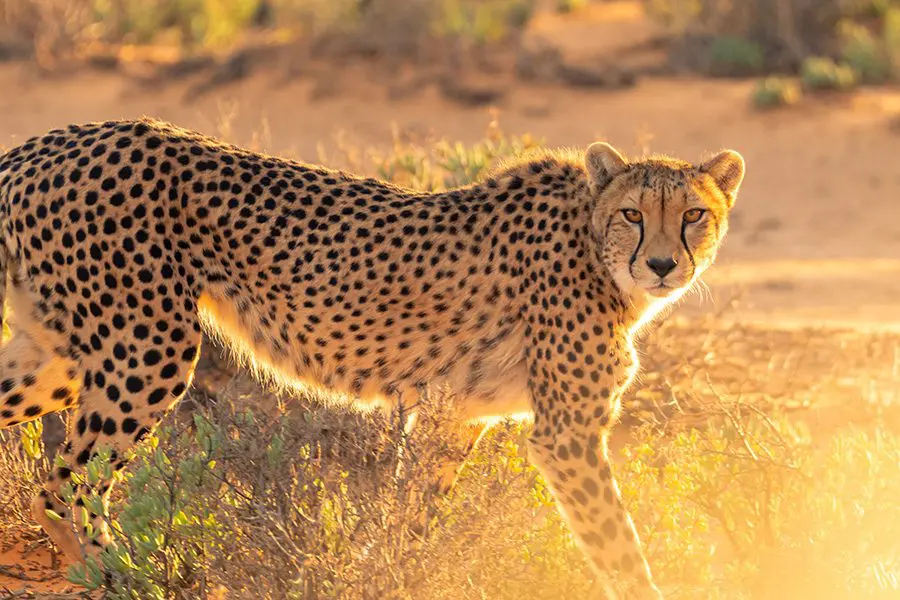
The cheetah is perhaps Namibia’s most iconic cat. The Namibian population belongs to the subspecies Acinonyx jubatus jubatus, the southeastern African cheetah.
Globally, cheetahs are listed as Vulnerable by the IUCN, although several scientists have argued that the species merits Endangered status because of continuing declines and fragmentation. Namibia’s national Red List already classifies the cheetah as Endangered. (izw-berlin.de)
Namibia is critically important for cheetah conservation because it supports one of the largest free-ranging cheetah populations in Africa, commonly estimated at around 1,500 animals. Most of these cats live outside protected areas on livestock and game ranches. (Cheetah Conservation Fund)
The country is also home to the internationally renowned Cheetah Conservation Fund, founded by Laurie Marker in 1990 near Otjiwarongo. The organization has led decades of research into cheetah genetics, ecology, conflict mitigation, and livestock-guarding dog programs. Scientific studies based on Namibian cheetahs have examined everything from genetic diversity to movement ecology. (PMC)
Recent nationwide camera-trap and GPS collar surveys have attempted to produce the first rigorous national cheetah estimate for Namibia. These projects involve Namibia’s Ministry of Environment, Forestry and Tourism together with the Leibniz Institute for Zoo and Wildlife Research. (Conservation Namibia)
Namibia has also supplied cheetahs for international rewilding and conservation translocation projects, including India’s controversial Project Cheetah initiative.
4. Caracal - Southern and Eastern Caracal
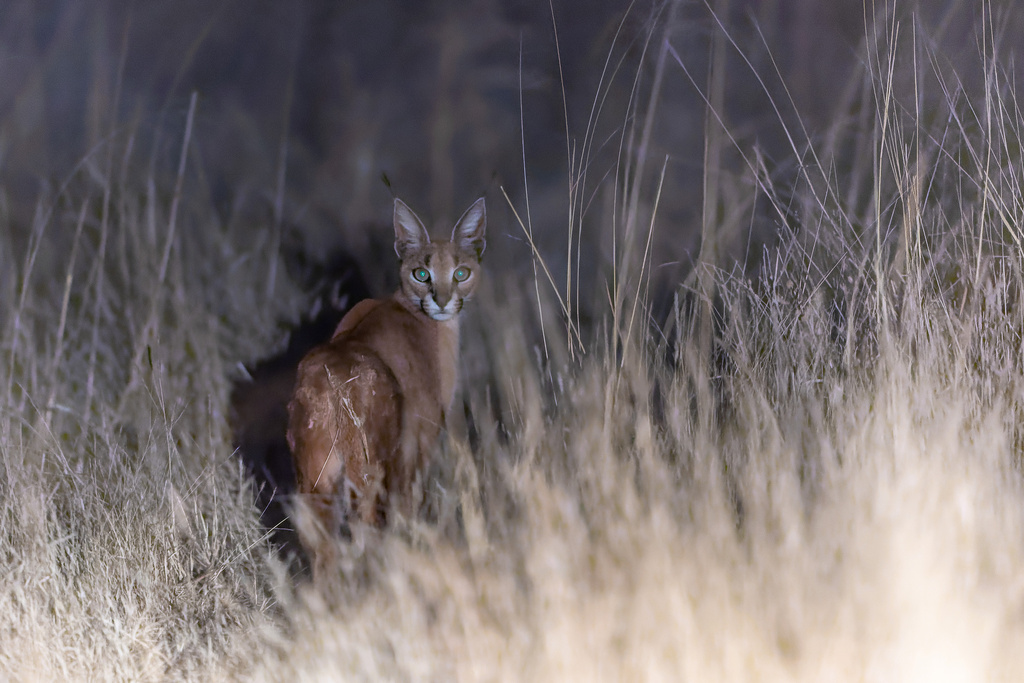
The caracal is one of Namibia’s most secretive medium-sized cats. Unlike the spotted cats, the caracal has a sleek reddish coat and long black ear tufts that make it instantly recognizable. The subspecies occurring in Namibia is the Southern and Eastern Caracal Caracal caracal caracal.
Globally, the caracal is listed as Least Concern by the IUCN because of its broad range across Africa and parts of Asia. In Namibia it is still relatively widespread, especially in arid and semi-arid habitats and also classified as Least Concern nationally.
Caracals are powerful hunters capable of taking prey much larger than themselves, including springhare, birds, rodents, and young antelope. In farming regions they occasionally prey on sheep and goats, bringing them into conflict with farmers.
Compared with lions, leopards, and cheetahs, the caracal has received less scientific attention in Namibia, although camera-trap surveys increasingly record the species across conservancies and ranchlands
5. Serval - Southern Serval
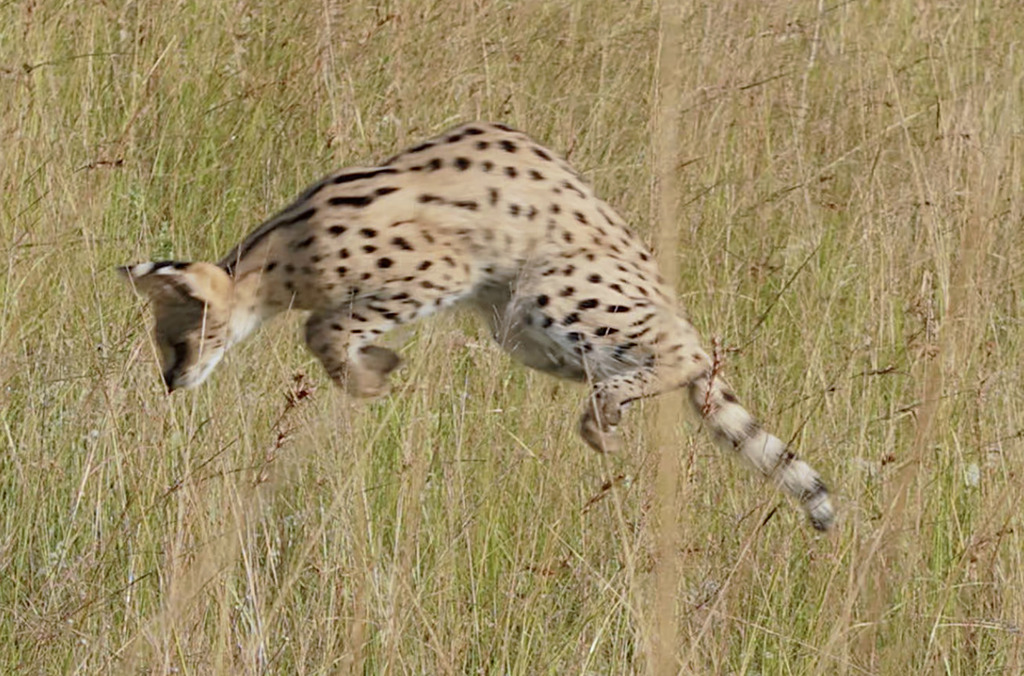
The elegant serval is one of Namibia’s least frequently seen cats because it prefers wetter habitats with dense grass cover. In Namibia, servals occur mainly in the north and northeast, especially near wetlands, river systems, and floodplains. The subspecies here is the Southern Serval Leptailurus serval serval.
Globally, the serval is listed as Least Concern by the IUCN. However, Namibia’s national carnivore Red Data Book considers the species Near Threatened because suitable wetland habitat is limited and fragmented within the country. National estimates suggest perhaps 1,500–4,000 servals remain in Namibia. (Cheetah Conservation Fund)
Servals are superb rodent hunters and use their extraordinarily long legs and oversized ears to locate prey hidden in grass. They are especially associated with the Zambezi Region and the wetter environments around the Kavango system.
Threats include wetland degradation, road mortality, and incidental trapping. Because servals are naturally uncommon in much of arid Namibia, even moderate habitat loss can affect local populations.
6. African Wildcat - Southern African Wildcat
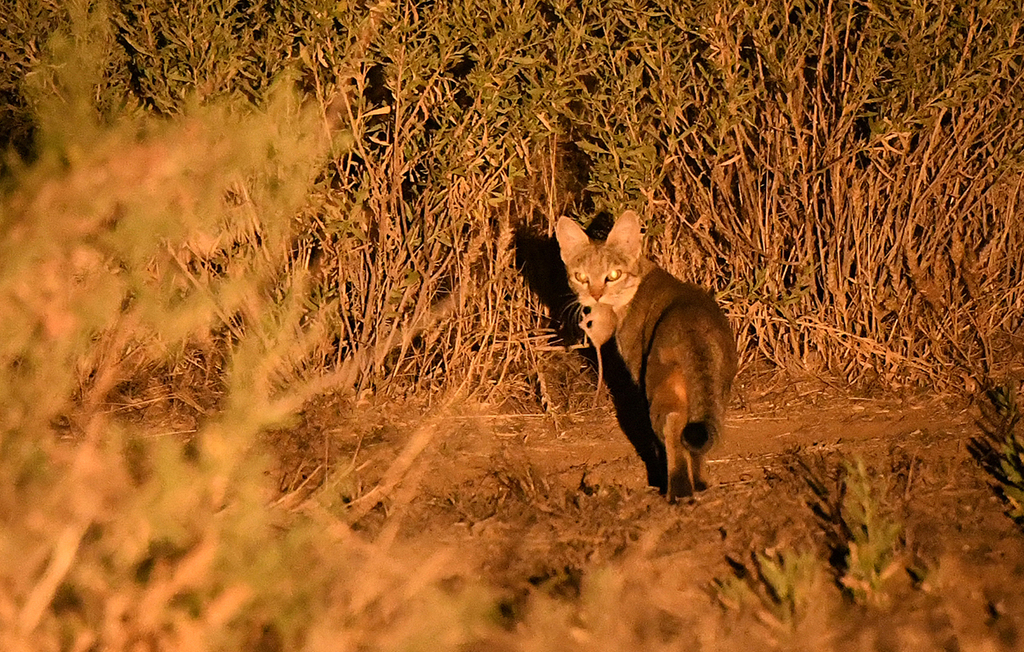
The African wildcat is the ancestor of the domestic cat and remains widespread across Namibia. It occupies savannas, deserts, scrublands, and even mountainous terrain. The subspecies found in Namibia is the Southern African Wildcat Felis lybica cafra.
Globally, the African wildcat is listed as Least Concern. In Namibia it is still common in many areas, and also listed as Least Concern nationally, although one major concern is hybridization with feral domestic cats. Genetic mixing can threaten the integrity of truly wild populations.
African wildcats are small but highly effective hunters of rodents, reptiles, birds, and insects. They are primarily nocturnal and extremely difficult to distinguish from domestic tabby cats without close observation.
Because the species is so widespread and elusive, population estimates in Namibia remain uncertain. Nevertheless, the country likely holds healthy populations across much of its interior.
7. Black-footed Cat
The black-footed cat is Namibia’s rarest and perhaps most fascinating feline. This tiny predator weighs as little as 1–2 kilograms and is one of the smallest cat species in the world. Despite its size, it has a formidable reputation as a highly efficient hunter. Black-footed cats are not classified into subspecies and the Namibian population would be part of the northern race.
Globally, the black-footed cat is classified as Vulnerable by the IUCN, and Namibia’s national Red Data Book also lists it as Vulnerable. Recent Namibian assessments estimate approximately 2,600 individuals nationally. (Cheetah Conservation Fund)
The species occurs mainly in arid grasslands and Karoo-type habitats in southern Namibia. Black-footed cats are notoriously difficult to study because they are nocturnal, secretive, and occupy low densities.
Namibia plays an important role in ongoing black-footed cat research. Long-term telemetry and ecological studies in southern Africa have transformed scientific understanding of the species’ hunting behavior, home ranges, and reproductive ecology. Research has shown that black-footed cats can successfully catch prey in roughly 60 percent of hunting attempts, an extraordinary figure for a wild predator.
Conservation concerns include habitat degradation, poisoning aimed at jackals, road mortality, and declining prey abundance.

Namibia’s Importance for Wild Cat Conservation
One of Namibia’s greatest conservation successes is its communal conservancy system. Unlike many African countries where wildlife survives mainly inside national parks, a substantial proportion of Namibia’s carnivores occur on shared landscapes involving farms, conservancies, and community-managed land.
This model has helped several cat species persist outside formal protected areas. However, coexistence remains fragile. Human-wildlife conflict, fencing, habitat fragmentation, poisoning, and illegal killing continue to threaten many populations. (ScienceDirect)
At the same time, Namibia remains one of Africa’s leading countries for carnivore research. Studies involving camera trapping, satellite telemetry, genetics, and community conservation continue to produce globally important data on lions, leopards, cheetahs, and smaller cats.
Best Places in Namibia to See Wild Cats
Some of the best protected areas and reserves for observing Namibia’s wild cats include:
Etosha National Park – excellent for lions, leopards, cheetahs, and African wildcats.
Namib-Naukluft National Park – desert-adapted predators and occasional caracals.
Skeleton Coast National Park – remote habitat for desert lions and leopards.
Bwabwata National Park – wetter habitat supporting servals and leopards.
Mudumu National Park – northeastern wetlands and riverine habitats.
Nkasa Rupara National Park – important for servals and leopards.
Okonjima Nature Reserve – internationally known for leopard and cheetah research.
Erindi Private Game Reserve – good predator viewing including lions and leopards.
N/a’an ku sê Wildlife Sanctuary – carnivore conservation and rehabilitation work.
Key Sources
IUCN Red List of Threatened Species
Conservation Status and Red List of the Terrestrial Carnivores of Namibia (MEFT / LCMAN / NCE)
Leibniz Institute for Zoo and Wildlife Research
Oxford Academic – Journal of Heredity cheetah genetics studies
Biological Conservation journal articles on Namibian carnivores
Namibia Ministry of Environment, Forestry and Tourism publications
Peer-reviewed carnivore ecology and camera-trap studies from Namibia (PMC)