
African Golden Cat (Caracal aurata) Information & Facts



Summary:
- Camera traps are widely used to monitor biodiversity and guide conservation actions, but a first-of-its-kind study finds the technology isn’t as prevalent in highly biodiverse areas that face the most threats from human activities, such as the Congo Basin and the Amazon Rainforest.
- Even in areas with a high number of camera-trap studies, nearly two-thirds were conducted outside the regions facing the highest risk of animal extinctions.
- Country income, accessibility, mammal diversity and biome largely determine the locations of nearly two-thirds of camera-trap research.
- Experts suggest expanding the network of camera-trap studies, building capacity among local research communities, and leveraging tools and platforms that help with data sharing and analysis to address these disparities.
"A straightforward way to address the disparities, researchers say, is by expanding camera-trap studies into areas where they’re currently lacking, such as the Congo and Amazon basins. However, Mugerwa cautions against doing so through “helicopter research,” the practice of researchers from the Global North going to countries in the Global South for research but leaving without training the local researchers or benefiting communities."
Based on: Mugerwa, B., Niedballa, J., Planillo, A., Sheil, D., Kramer‐Schadt, S., & Wilting, A. (2023). Global disparity of camera trap research allocation and defaunation risk of terrestrial mammals. Remote Sensing in Ecology and Conservation, 10(1), 121-136. doi:10.1002/rse2.360
Read the full article at:
Regions with highest risks to wildlife have fewest camera traps, study finds (mongabay.com)
by Spoorthy Raman - science journalist
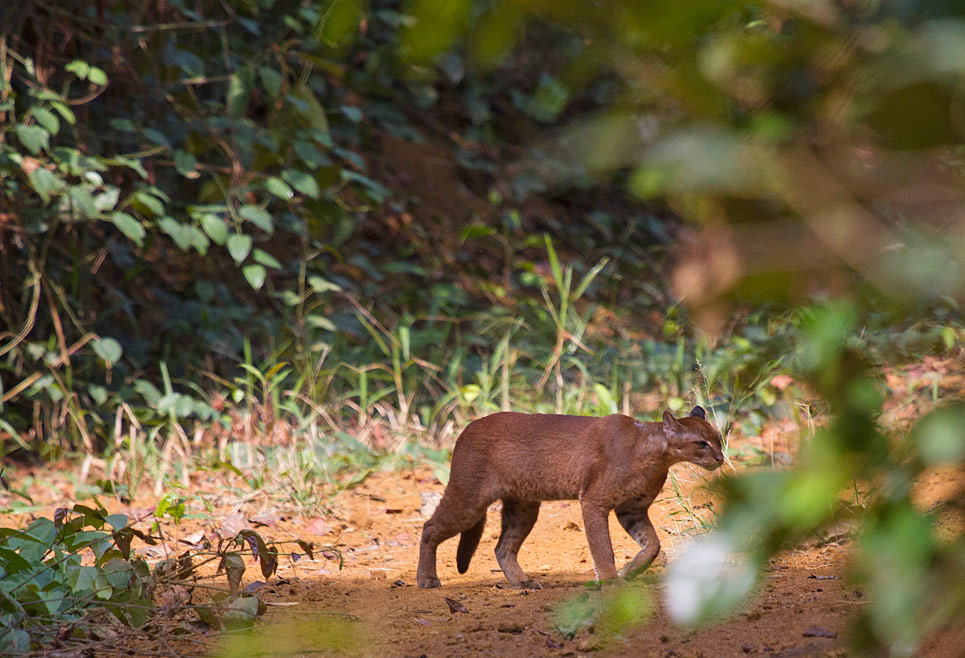
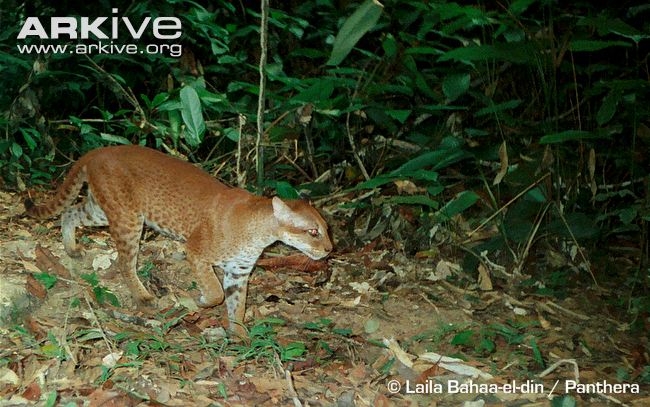
"Of the African cats, the one you’re least likely to have heard of is the African golden cat. It lives in the rainforests along the Equator, is very shy, and successfully avoids people – that is until it falls into a hunter’s snare. Imagine a stocky caracal but without the pointy, tufted ears. It weighs 10 kg on average and, despite the “golden” moniker, it varies in colour from red to grey and sometimes black. It generally has markings on its underbelly and the inside of its limbs, but they sometimes extend across the whole body. We know almost nothing about its behaviour and breeding biology in the wild.
So what was I doing here, deep in the forests of Gabon? My study aimed to estimate how many golden cats there are and to see how human activities affect them. I collected data from six different areas in Gabon, some of which were protected, some were subject to logging, and some were regularly hunted.
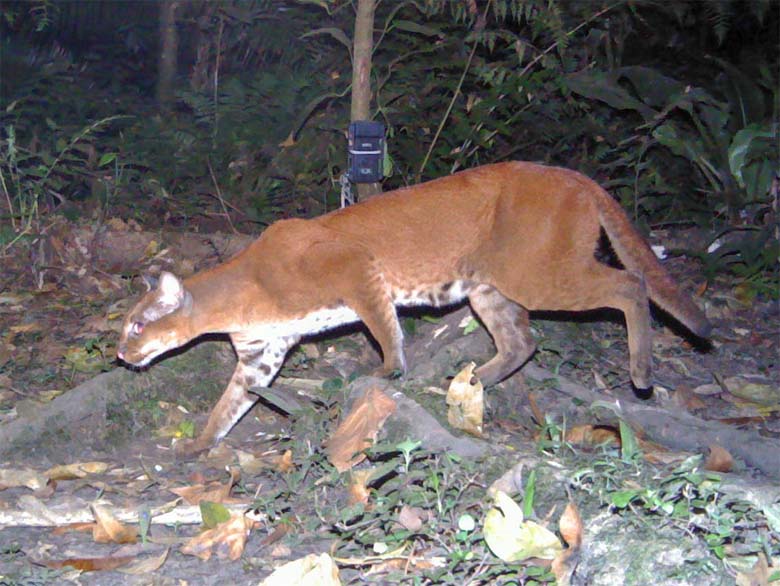
The camera trap is the obvious tool to study such a shy animal in the forest. Set up to work remotely; the camera is activated by an infrared sensor every time an animal passes by. These traps gave me the eyes to see everything my ears and nose were sensing as I walked the forest trails. Looking through the images was the highlight of my work – a silverback gorilla proudly standing his ground, a giant pangolin searching for termites, a goshawk clasping a squirrel it has just caught, and some elephants greeting each other. Sadly, there was also the occasional hunter, catch in hand. But most importantly, there were many photos of golden cats, providing me with the data I needed to make my assessment."
Read the full article at:
Finding gold in Gabon - the golden cat (Africa Geographic)
by Laila Bahaa-el-din - PhD candidate University of KwaZulu-Natal (South Africa) and the Wildlife Conservation Research Unit (WildCRU) at the University of Oxford (UK).
Summary:
- The golden cat is so mysterious it wasn’t photographed in the wild until 2002, and researchers still disagree on its scientific name.
- Some suggest there are 10,000 left in the wilds of Equatorial Africa, but no one really knows.
- The African golden cat is most threatened by habitat loss; its stronghold is in the Congo Basin.
"Uncertainty and mystery shroud the golden cat: it’s one of the world’s least-studied felines. The first known photo of a wild individual in its habitat was not taken until 2002 by Phil Henschel, Lion Program Survey Coordinator for Panthera. Wildlife researchers can spend decades working in African equatorial forests without ever seeing one in the flesh, and that includes David Mills who studies the species for the Kibale Project in Uganda, Wildlife Conservation Society Uganda, and Panthera.
However, newly developed and deployed camera trap technology has been a game changer; it is allowing researchers to learn a lot, and quickly.
Since 2010, we have conducted seven camera surveys and accumulated nearly 300 independent golden cat captures in over 18,000 trap days,” David Mills told mongabay.com.
One of the first thing scientists learned is that the golden cat is far more vulnerable to extinction than anyone knew."
Feline Unseen: The African Golden Cat (mongabay.com)
by Sean Mowbray - science journalist