

African Wildcat Videos ~ the Ancestor of Domestic Cats

- Evolution of the African Wildcat
- African Wildcat Videos
- Lion Mountain TV: African Wildcat attacked by Tawny Eagle in Namibia.
- BBC Earth: African Wildcat brings prey to her kitten in the Serengeti.
- BBC Earth: African Wildcat pair disturbed by a mongoose and a caracal in the Serengeti.
- BATB1000: Sighting of African Wildcats with kittens in the Kgalagadi National Park.
- Nico Boulder: Male African Wild Cat, Kgalagadi.
Header Image Credit
Evolution of the African Wildcat
The African Wildcat (Felis lybica or Felis silvestris lybica), a small, solitary predator native to Africa and parts of the Middle East, is considered the ancestor of the domestic cat (Felis catus). Over thousands of years, through a combination of natural selection and human intervention, the African Wildcat evolved into the domestic cat, one of the most common companion animals in households today. This essay explores the evolutionary history of the African Wildcat and how it became the ancestor of domestic cats.
African Wildcats
The Felis genus is part of the larger cat family, Felidae, which diverged from other carnivorous mammals around 25 million years ago. Felis lybica, the African Wildcat, evolved roughly 2 million years ago. Its ancestors adapted to a variety of environments, from arid deserts to dense forests, and are primarily solitary creatures. These cats exhibit a range of behaviors well-suited for survival, including excellent hunting skills, territoriality, and adaptability to different prey types.
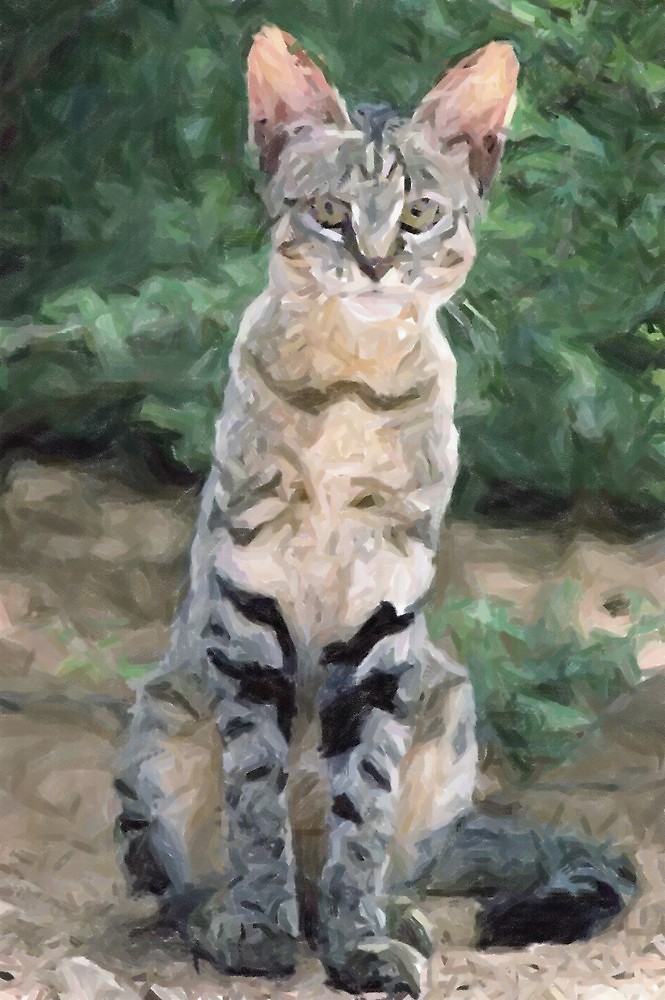
The African Wildcat closely resembles the domestic cat in terms of size, coat coloration, and behavior. These cats are small, with an average weight of 3 to 5 kilograms, and their coats are typically a tawny or grayish-brown with faint stripes, providing camouflage in their natural environments. Their diet consists primarily of small mammals, birds, and insects, and they hunt using stealth and quick reflexes, traits that would later prove advantageous for domestication.
Domestication and the Role of Humans
The process of domestication of the African Wildcat is believed to have begun around 9,000 years ago in the Near East. As human agricultural practices flourished, they began storing surplus grain, which attracted rodents. The rodents, in turn, attracted wildcats. Over time, these cats adapted to living near human settlements, where food sources were abundant. Unlike other wild animals, the African Wildcat did not need to be tamed through active human intervention. Instead, a process of self-domestication occurred.
The wildcats that were more tolerant of human presence likely had a higher success rate in areas with abundant food sources. These cats were also less fearful of humans, which increased their chances of survival and reproduction in proximity to humans. Over generations, these cats evolved to be more sociable, with some becoming more accepting of human interaction. The process was gradual, with natural selection favoring traits such as reduced aggression and a higher tolerance for human contact.
Genetic Evidence and Domestication
Genetic studies have confirmed that domestic cats share a significant portion of their DNA with the African Wildcat, supporting the theory of their common ancestry. Recent research using mitochondrial DNA has shown that the domestic cat's genetic lineage traces back to a small number of wildcat ancestors that lived in the Middle East. The genetic differences between domestic cats and wildcats are minimal, suggesting that the domestication process involved only slight changes in behavior and physical traits.
Conclusion
The African Wildcat’s evolution into the domestic cat is a fascinating example of how a wild species can adapt to human presence and eventually become a companion animal. Through a combination of environmental factors, natural selection, and minimal human influence, the African Wildcat gave rise to the domestic cat we know today. This evolution demonstrates the close bond between humans and cats, a relationship that has developed over thousands of years, leading to the domesticated animals that are now integral parts of households worldwide.
References:
Driscoll, C. A., et al. (2007). "The Near Eastern origin of cat domestication." Science, 317(5837), 519-523.
Vigne, J. D., et al. (2004). "Early domestication of the cat in Egypt." Nature, 430, 467-473.
Clutton-Brock, J. (1999). A Natural History of Domesticated Mammals. Cambridge University Press.


African Wildcat Videos
These videos about the African Wildcat show footage about these ancestors of our domestic cats. As you will see they look very much like an ordinary tabby cat, however African Wildcats have a distinctive reddish colouring on the backs of their ears, the underside of the body and on the hind legs. They are also slimmer, have longer legs and high shoulder blades which give them a distinctive gait that differs from domestic cats. Look out for these traits in the videos.
These video clips are all taken in the wild in Africa, some are from professional wildlife documentaries and others are amateur footage of exceptional sightings.
(We use the spelling 'Wildcat' to distinguish this as a cat species and avoid confusion with the general term 'wild cat'.)
Discover more information about African Wildcats, African Wildcat characteristics and African Wildcat distribution in Africa.
Main reference for the video introductory texts: Chapter 'Wildcat' from Wild Cats of the World by Luke Hunter - on our list of recommended books on wild cats.
Lion Mountain TV: African Wildcat attacked by Tawny Eagle in Namibia.
The African Wildcat diet consists mainly of rodents and lagomorphs (hares and rabbits) followed by birds, and in particular ground foraging birds such as doves and pigeons. African Wildcat predators include the larger wild cats and large raptors. This clip shows an African Wildcat's amazing leaping ability in hunting Cape Turtle Doves, but then the cat gets attacked itself by a Tawny Eagle.

Stream a new African Safari every night
Presented by the highly experienced safari guide James Currie, this exciting series takes you onto the plains and into the jungles of Africa.
From UNESCO World Heritage sites to stunning bird sanctuaries, and from national parks to hidden-gem wilderness areas, experienced travelers and armchair enthusiasts alike will enjoy this exhilarating tour of Africa.
BBC Earth: African Wildcat brings prey to her kitten in the Serengeti.
African Wildcats breed seasonally in climates of extreme seasonal temperatures such as in the desert regions, but elsewhere in milder climates they breed throughout the year, with a peak during the rainy season in eastern and southern Africa. There are usually two to four kittens in a litter and one female can produce multiple litters in a year.
In this video clip an African Wildcat female catches a live mouse to teach her kitten how to hunt.
BBC Earth: African Wildcat pair disturbed by a mongoose and a caracal in the Serengeti.
As with most wild cat species, African Wildcats live a solitary existence and adults only interact during mating or territorial fighting. Males have large ranges (Kalahari average 7.7km²) that overlap with a number of female territories (Kalahari average 3.5km²).
In this video clip an African Wildcat male is attempting to mate with a female, but keeps getting disturbed by passing wildlife.
BATB1000: Sighting of African Wildcats with kittens in the Kgalagadi National Park.
"A very rare sighting of not only one but two adult African Wildcats attending a litter of three small kittens in the Kgalagadi National Park."
Nico Boulder: Male African Wild Cat, Kgalagadi.
This video shows the distinct markings and characteristic gait of African Wildcats. The coat has faint vertical stripes on the body, with dark rings on the legs as well as on the black-tipped tail. The chin and throat are white and the chest is usually paler than rest of body. There is a distinctive reddish colouring on the belly, backs of the ears and hind legs. Also notice the dark under-soles of the feet which can sometimes cause naming confusion with the Black-Footed Cat which is a totally different species.