

Black-footed Cat (Felis nigripes) Information and Facts


from the the book Cats of Africa
NAME & STATUS
 Common Names
Black-footed Cat
Small Spotted Cat
Scientific Name
Felis nigripes
Subspecies
None
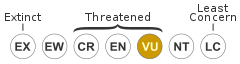
IUCN Red List Status
VU Vulnerable
IDENTIFICATION
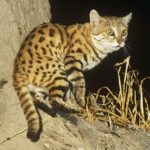
Appearance
Half size domestic cat
Similar to domestic cat
Coat
Body - small black spots
Legs - stripes, Soles - black
Tail - rings, black tip
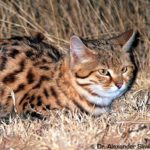
Head
Broad skull, diagonal facial lines
Ears - plain, slightly rounded
SIZE
Weight
Males: 1.5 to 2.45 kg
Females: 1.0 to 1.6 kg
Head + Body Length
Males: 36.7 to 52.0 cm
Females: 35.3 to 41.5 cm
Tail Length
12 to 20 cm
DISTRIBUTION

Range
Southern Africa:
South Africa
Botswana
Namibia
Habitat
Savanna - Dry
Grassland - Subtropical
Desert - Hot
LIFE CYCLE
 Gestation
63 - 68 days
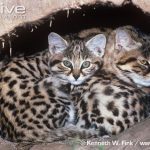
Litter Size
1 - 2 kittens (max 4)
Sub-Adult
3 - 4 months
Maturity
Females 7 mths - Males 9 mths
Lifespan
8 yrs wild - 16 yrs captivity
DIET / PREY

Major to Minor by Weight
Mammals - small rodents
Small birds
Reptiles
Amphibians
Invertebrates
Scavenge - Yes
Hunting Success Rate
60%
BEHAVIOUR
Activity
Solitary
Nocturnal
Territorial
Inhabits burrows or anthills
Avg Range Size
Females 8.6 km²
Males 16.1 km²
Density 16.7 cats / 100 km²
TAXONOMY
Kingdom: Animalia
Phylum: Chordata
Class: Mammalia
Order: Carnivora
Suborder: Feliformia
Family: Felidae
Subfamily: Felinae
Genus: Felis
Species: Felis nigripes
Subspecies: none

Permission given to download for offline Personal or Educational use only
Kindly credit www.WildCatsofAfrica.info


Summary:
- Black-footed cats (Felis nigripes) are the smallest and also one of the rarest wildcat species in Africa. They’re very reclusive, extremely hard to find, and are among the least-studied nocturnal mammals on the continent.
- Data-scarce species like the black-footed cat are difficult to conserve because the most basic knowledge — of their home ranges, territories, habitat, and reproductive, dietary and other behaviors — is often lacking. Without these many life-cycle details, the targeting of effective preservation strategies is near impossible.
- German ecologist Alexander Sliwa has made it his life’s mission to research the elusive black-footed cat. Establishing and working with a small team, he eventually led the way to the formation of the Black-footed Cat Working Group. Thanks largely to those efforts, a substantial database on Felis nigripes now exists.
- This work led to the black-footed cat being listed as vulnerable on the IUCN Red List. Though the species’ survival remains far from secure, the design and implementation of conservation strategies will no longer have to start from scratch, and can be built on valuable, already accumulated baseline data.
“It is impossible to provide a prognosis for the species’ survival: “Nobody knows,” Sliwa says. Global warming, new diseases or more intensive use or other impacts on their rangelands are only some of the factors that can cause the species to “slip quietly into extinction.” Despite more media attention, including a feature by the BBC, people are still not very aware of the small cat, he says, and funding to continue the research is a constant battle — as is the case with most small wildcat species.”
Read the full article republished at:
‘Anthill tiger’: Putting one of Africa’s rarest wildcats on the radar (mongabay.com)
by Petro Kotzé - science journalist, South Africa
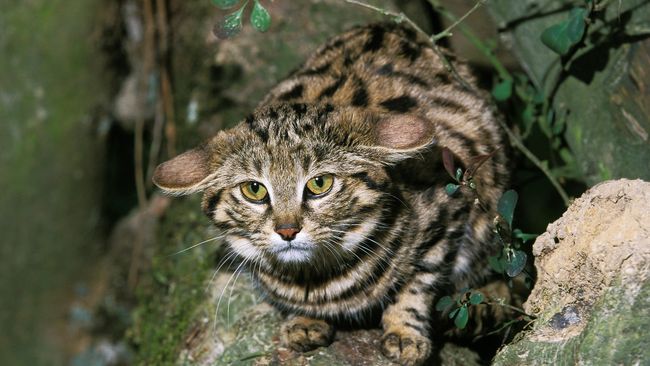
(Image credit: slowmotiongli via Getty Images)
Excerpt:
Black footed cats are already a threatened species, and habitat fragmentation is now causing increased rates of interbreeding, placing them at higher risk of disease.
A new study, published on Jan. 2 in the journal PNAS, suggests that black-footed cats may now be suffering from genetic isolation and inbreeding.
The researchers sequenced the genome of 10 black-footed cats and combined them with previously public genomic data. Their analysis showed markers of recent inbreeding events, which may have increased as a result of habitat fragmentation.
Projects such as roads or farms can fracture an animal's natural habitat, splitting up communities of potential breeding partners.
Read the full article at:
Adorable but deadly little wildcat may be inbreeding at 'alarming' rates, study finds ~ Live Science
by Jacklin Kwan - science journalist UK
Excerpt:
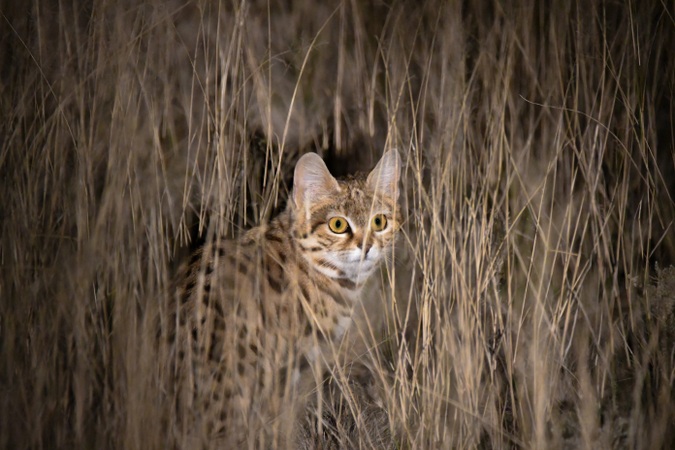
1. Even though this member of the genus Felis looks more like an adorable moggie, it is believed to be the world’s deadliest cat. They achieve the highest kill rate, successfully taking their target in 60% of hunts. Other wild cats often spotted on your African safari, such as lions and leopards, rarely succeed more than 20-40% of the time.
2. This tiny cat is perhaps the smallest of all wild cat species in Africa. The total length of its body is between 50-72 cm (including the tail). The male weighs between 1.7-2.4 kg while the female is only 1-1.6 kg. Kittens weigh a mere 60-90 g when born. They are so small that they do not even trigger conventional camera traps, making them difficult to study. For this reason, it is tricky for researchers to estimate the number of black-footed cats in the wild, but it is believed that there are less than 10,000 mature individuals in the wild, and that the population is declining. For these reasons, the black-footed cat is listed as ‘vulnerable’ on the IUCN Red List.
Read the full article at:
9 Fascinating facts about black-footed cats - Africa Geographic
by Team Africa Geographic