African Serval Cat Description
Serval Physical Characteristics
African Servals are similar in size to Caracals and also classed as medium sized cats, however they are more slender and taller.
Size
Servals are about two to four times larger than domestic cats. The average adult Serval cat size dimensions are:
- Females weigh between 9 and 11 kgs and their body length, including the tail, is 68 to 93 cm.
- Males weigh between 11 and 13 kgs and their body length, including the tail, is 71 to 95 cm.
- The tail is usually about a third of the body length, between 25 to 32 cm.
- Shoulder height is between 53 to 60 cm.
Body
The Serval is a slender cat with long legs and a short tail. The legs are proportionally the longest to its body size of all the wild cats.
Coat
The coat pattern of a Serval cat is variable but usually pale yellow with different sized spots, some of which merge into longitudinal stripes down the back and neck. The underparts are paler but usually also spotted. The tail has black rings and has a black tip.
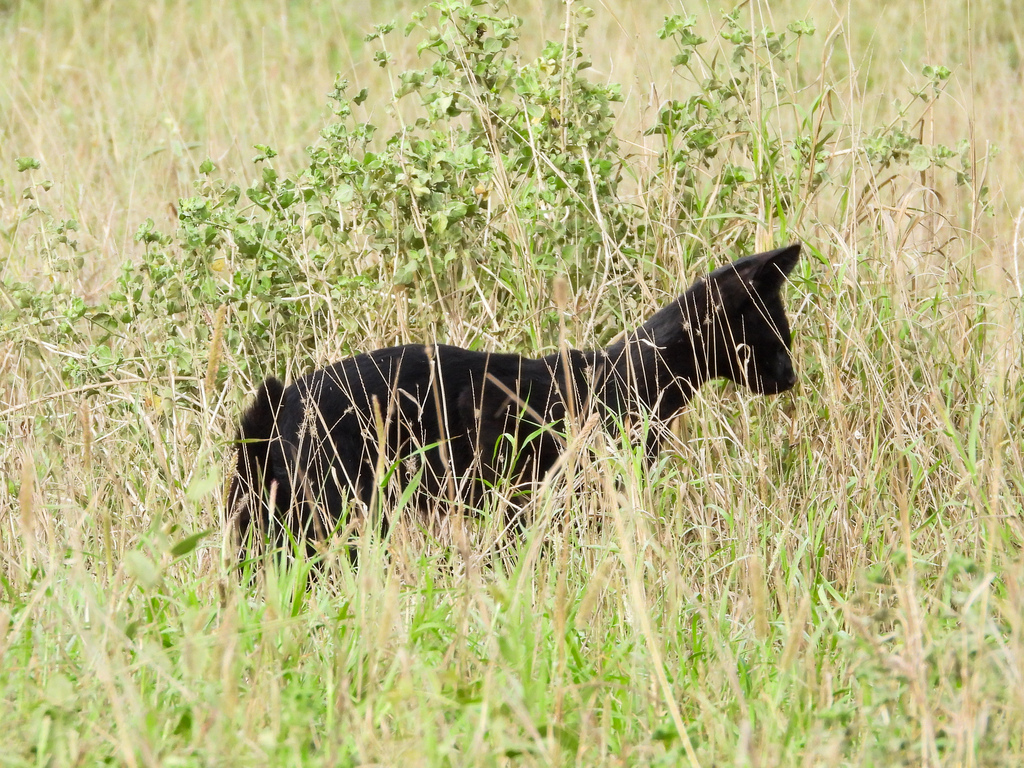
Melanistic (black) Servals occur with the spotted pattern still showing through on the dark coat.


Serval Facial Characteristics
Head
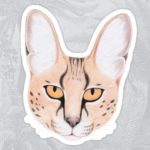
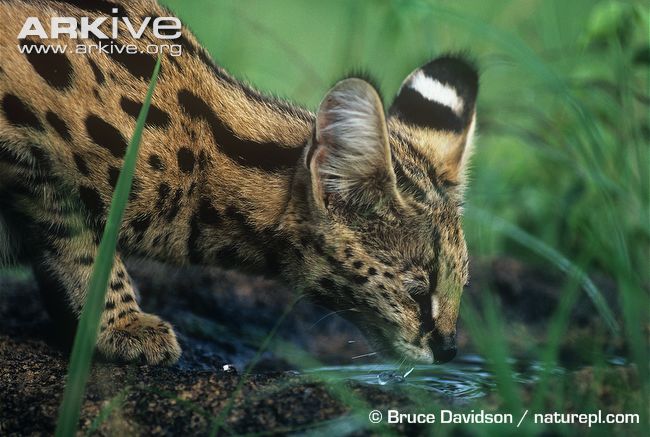
The Serval cat also has spots on its face, continuing from its body pattern. There are dark 'tear marks' below the eyes, similar to a Cheetah but not as clearly defined. The black colouration of the nose extends to the skin above the nose. As with many cats, there are white stripes around the eyes and the muzzle is white extending below on the chin.
Ears
The large, oval ears are set close together and are a distinguishing feature of Servals. They have the largest ears proportionally to their body size of all the wild cat species. The backs of the ears are black with a distinct white patch across the centre. The Serval's ears are one of the most distinctive among the ears of all ten African wild cats.

Stream a new African Safari every night
Presented by the highly experienced safari guide James Currie, this exciting series takes you onto the plains and into the jungles of Africa.
From UNESCO World Heritage sites to stunning bird sanctuaries, and from national parks to hidden-gem wilderness areas, experienced travelers and armchair enthusiasts alike will enjoy this exhilarating tour of Africa.
Serval Identification
Overall, the Serval cat is about the size of a medium sized dog with a spotted coat. It can often be confused with Cheetahs and Leopards which also have spotted coats. Servals have a mixture of small and large, often irregular shaped, spots and even stripes on their coats, whereas Cheetahs tend to have similar sized solid circular spots all over their body. Leopards have a rosette shape pattern which is a cluster of smaller spots encircling a dark patch.
The very large ears of Servals are also distinctive compared to the small, rounded ears of Cheetahs and Leopards. Servals also have much shorter tails that do not reach the ground when they are standing whereas both Leopards and Cheetahs have long tails.
When catching a glimpse of wildlife in the bush it is often difficult to identify an animal, especially if lighting is poor, or you do not see the full animal. The pointers above will help you confirm whether what you saw was a Serval cat.

Geographic Variation in the Serval
Although Servals throughout Africa share the same distinctive combination of long legs, large ears, a short tail and a spotted coat, their appearance can vary considerably across their extensive range. The most obvious differences are in coat color and, particularly, the size and density of the spots. Typical Servals have a yellowish, tawny or buff background with black spots that can range from relatively small, freckle-like markings to much larger spots. The pattern may also change across the body, with spots tending to merge into stripes on the neck, shoulders and back. The coat pattern can vary between individual Servals as well as some regional variation in spot size from freckle-sized markings to large individual spots.
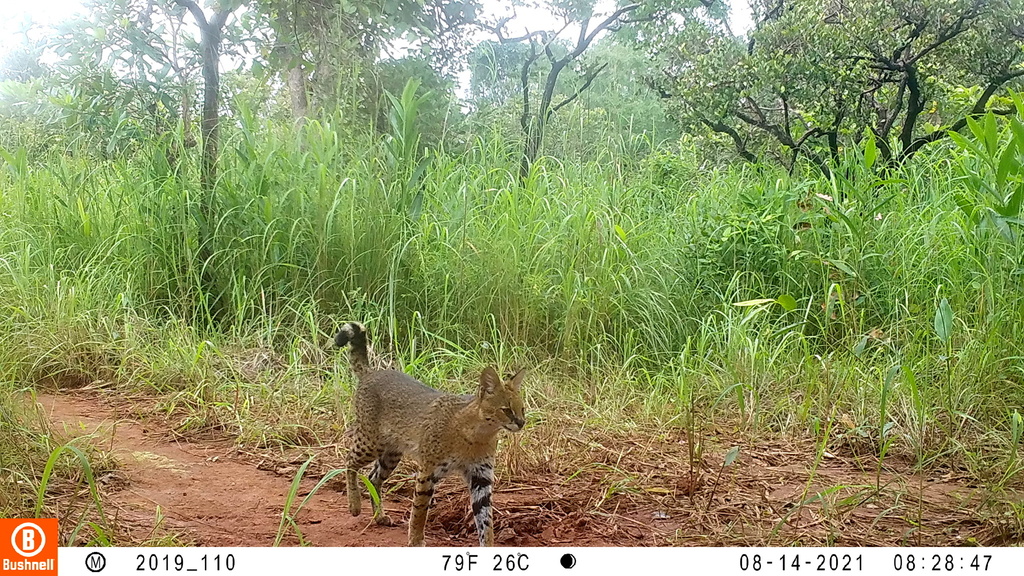
One particularly interesting variation is the servaline morph, sometimes called the small-spotted or speckled form. Rather than the bold spots and stripes of the more familiar Serval, these cats have a much finer, densely spotted coat. The servaline morph is rare and has been reported from the Democratic Republic of Congo and southwestern Uganda, where it appears to be associated with dense vegetation and secondary forest. Research from Odzala-Kokoua National Park in the Republic of Congo is particularly interesting: almost two-thirds of the Servals recorded during one camera-trapping study belonged to the servaline morph. This suggests that the small-spotted pattern may be particularly suited to, or at least associated with, more densely vegetated habitats.
Geographic Variation in the Serval cont.
Another striking variation is melanism, in which a Serval develops an unusually high concentration of the dark pigment melanin and appears almost entirely black. Melanistic Servals have been recorded in several parts of Africa, but they have traditionally been particularly associated with the highlands of eastern Africa, including Kenya's Aberdare Range and Mount Kenya, as well as the Ethiopian Highlands. One possible explanation is that a dark coat provides better camouflage in shaded forest and moorland habitats, while another theory is that it may have advantages in colder high-altitude environments. However, these explanations remain hypotheses rather than established facts.
Kenya has produced an especially intriguing example because melanistic Servals have also been recorded in Tsavo, a much lower-altitude and predominantly dryland environment. Records collected between 2011 and 2016 by the Sheldrick Wildlife Trust and Wildlife Works found that 47% of their Serval sightings in the Tsavo ecosystem were melanistic. The researchers emphasized that this surprisingly high proportion should not be interpreted as proof of an evolutionary advantage: melanistic animals may simply be easier to detect and report, particularly from aircraft. Other possibilities include local genetic factors, genetic drift or a founder effect. The unexpectedly high frequency of black Servals in Tsavo therefore challenges the traditional idea that melanism in this species is primarily an adaptation to cool, forested highlands, and highlights how much remains to be learned about geographic variation in the Serval.