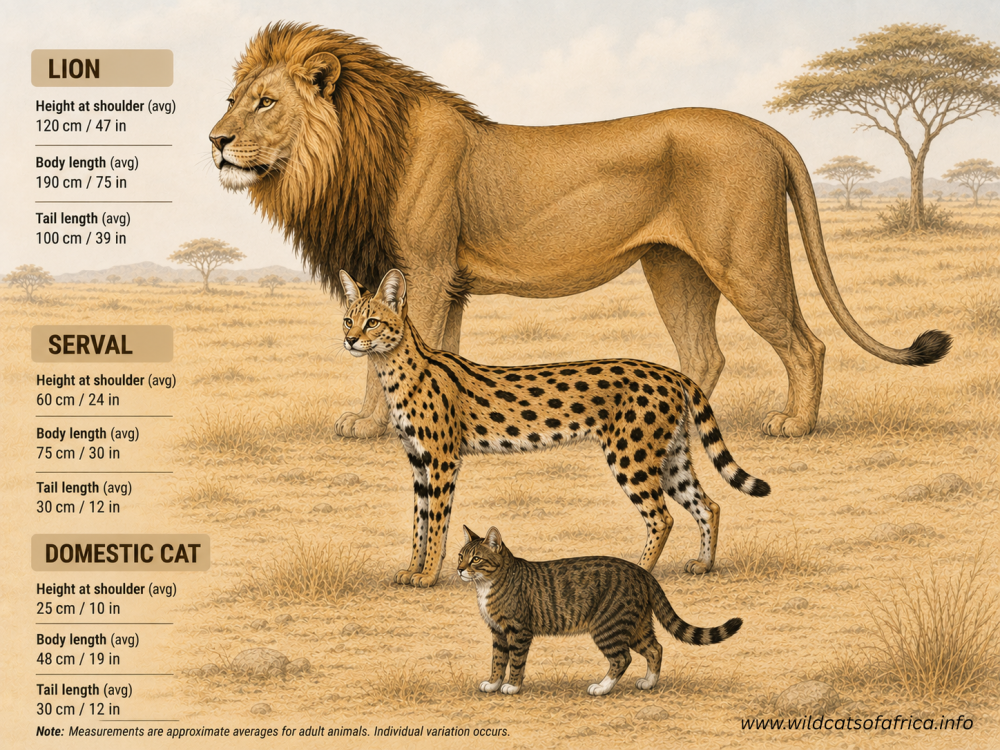
Serval Cat Size Comparison to Lion and Domestic Cat

Serval Cat Size with Comparison to Domestic Cats and Lions

The Serval (Leptailurus serval) is one of Africa's most distinctive wild cats. Although it is often described as a medium-sized felid, its unusual body proportions make it appear much larger than its actual weight would suggest. Long legs, an elongated neck, and exceptionally large ears give the serval a tall, elegant silhouette unlike any other member of the cat family.

Adult servals typically weigh between 7 and 18 kg (15-40 lb) and stand 54-66 cm (21-26 in) at the shoulder, placing them well above the average domestic cat in height while remaining much lighter than the larger members of the genus Panthera. Despite sharing a close evolutionary relationship with the caracal and African golden cat, the serval wild cat has evolved proportions specialized for hunting rodents and birds in tall African grasslands.

This article explains exactly how serval size is measured, compares the serval with domestic cats and related African wild cats, and explores why it's remarkable body proportions are unique among all living felids.

Understanding Animal Size Measurements

Zoologists use several standard measurements when describing mammals. Because different publications sometimes report different dimensions, it is helpful to understand what each measurement represents.

Head-body length

The most important measurement is head-body length (sometimes abbreviated HBL).

This is measured from the tip of the nose to the base of the tail. The tail is not included.

Most scientific books on wild cats, including those by Mel and Fiona Sunquist, Luke Hunter and the Handbook of the Mammals of the World, use head-body length because tail length varies considerably between individuals.

Tail length

Tail length is measured separately from the base of the tail to its tip.

Adding the head-body length and tail length together produces the total length, although scientific papers generally prefer to report the two measurements separately.

Shoulder height

Shoulder height measures the distance from the ground to the top of the shoulders (withers) while the animal is standing naturally.

This measurement is particularly important for servals because they have the longest legs relative to body size of any living wild cat.

Body weight

Weight is usually reported separately for males and females because servals show moderate sexual dimorphism.

Ear length

Although ear length is not always measured in field studies, the serval's ears are proportionally the largest of any cat species and are frequently discussed in anatomical studies because of their importance for hearing prey beneath vegetation.

Serval Cat Size: How Big Is the African Serval?

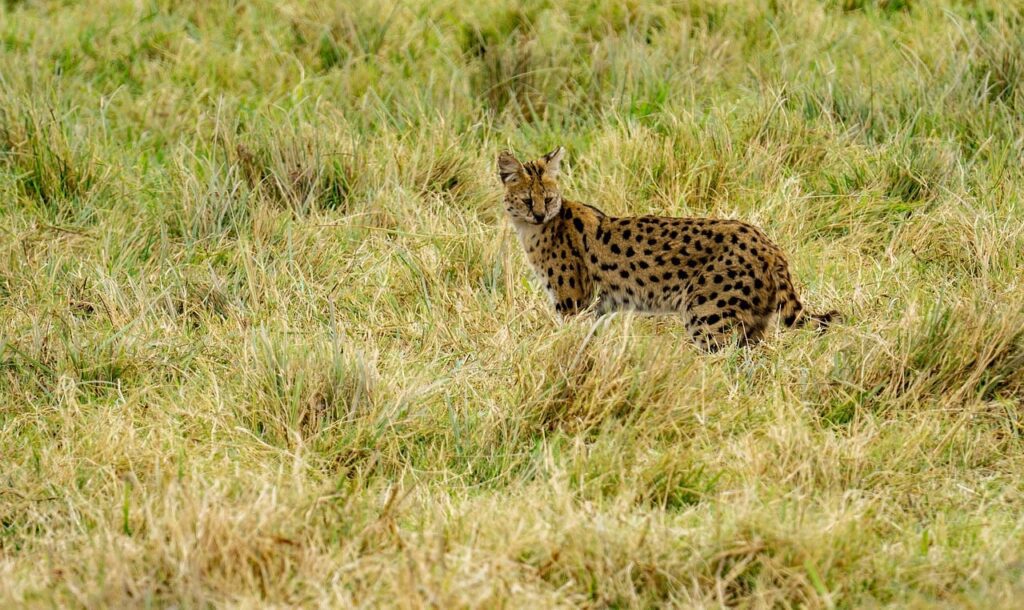
Eastern Serval Cat (Leptailurus serval lipostictus)
iNaturalist ~ Eastern Serval Observation Tanzania ~ ©Dirk Froebel CC BY-NC

Adult Serval Size

Recent references show remarkably consistent measurements across Africa.

Measurement

Metric

Imperial

Head-body length

59-92 cm

23-36 in

Tail length

20-38 cm

8-15 in

Total length

79-130 cm

31-51 in

Shoulder height

54-66 cm

21-26 in

Adult weight (female)

7-12 kg

15-26 lb

Adult weight (male)

9-18 kg

20-40 lb

Across multiple field references, an average adult typically measures approximately:

  • Head-body length: about 75 cm (30 in)

  • Tail: about 30 cm (12 in)

  • Shoulder height: about 60 cm (24 in)

  • Weight: around 11-13 kg (24-29 lb), with males averaging slightly heavier than females.

Why Does the Serval Look So Tall?

Body weight alone does not determine how large a cat appears.

Servals possess several anatomical adaptations that exaggerate their apparent size:

  • exceptionally long metatarsal bones

  • long tibiae

  • relatively narrow chest

  • slim build

  • elongated neck

  • large upright ears

  • short tail

Together these features produce a cat that appears almost "stilt-legged."

These adaptations evolved for hunting in long grass where seeing above vegetation and accurately locating prey by sound provides a significant advantage. Studies show servals successfully capture prey in nearly half of their hunting attempts, one of the highest success rates among wild cats.

Longest Legs Relative to Body Size

Perhaps the serval's most famous size fact is that its legs are proportionally the longest of any living wild cat.

Unlike larger cats, whose height increases mainly because of overall body mass, the serval has evolved unusually elongated lower legs.

These longer limbs allow it to:

  • see over tall grasses

  • leap vertically over 2 metres (6.5 ft)

  • pounce accurately on hidden rodents

  • cover wetlands efficiently while hunting

The elongated metatarsals and flexible toes are considered highly specialized adaptations among felids.

The Largest Ears Relative to Body Size

The serval also possesses the largest ears relative to body size of any cat species.

Rather than simply being large, the ears are:

  • broad

  • oval

  • positioned close together

  • highly mobile

More than twenty muscles control each ear independently, enabling the cat to pinpoint faint sounds produced by rodents beneath dense vegetation.

The large ear surface also improves directional hearing and helps dissipate heat in warm climates.

A Remarkably Long Neck

The serval's neck is another overlooked size adaptation. Compared with similarly sized felids, the neck is noticeably elongated.

This longer neck allows the serval to:

  • keep its head above tall grasses

  • maintain excellent binocular vision

  • direct its ears toward hidden prey

  • execute steep downward strikes during pounces

Combined with the long legs, the neck gives the serval an unusually upright posture that distinguishes it immediately from other medium-sized cats.

Comparing the Serval with Its Closest Relatives
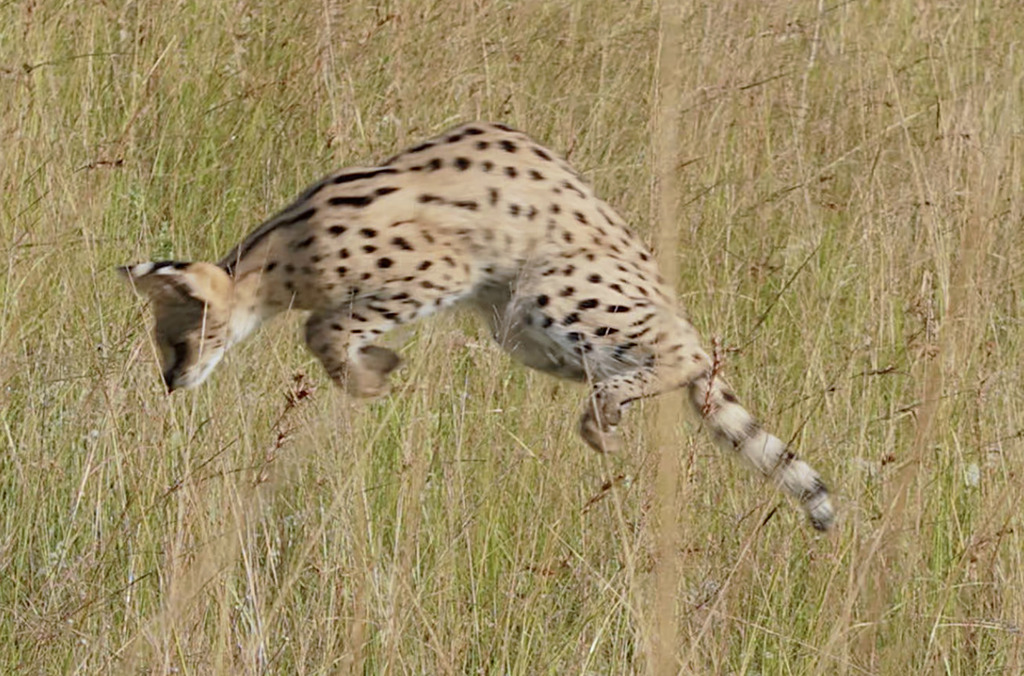
Southern Serval (Leptailurus serval serval)
iNaturalist · Southern Serval South Africa · © murraykeeton CC BY-NC

Modern genetic studies place the serval, caracal and African golden cat within the same evolutionary lineage.

Although similar in overall size, their proportions differ dramatically.

Feature

Serval

Caracal

African golden cat

Build

Slender

Muscular

Stocky

Legs

Longest relative to body

Moderate

Short relative to body

Neck

Long

Moderate

Short

Ears

Largest relative to body

Long with ear tufts

Rounded and comparatively small

Tail

Short

Short

Longer than serval

Compared with the Caracal

Caracals are similar in weight and overall body length, but have:

  • much shorter legs

  • a lower shoulder height

  • a shorter neck

  • triangular ears with black tufts instead of very large, rounded ears

The caracal is built more for explosive horizontal acceleration and powerful jumps than prolonged hunting in tall grass.

Compared with the African Golden Cat

African golden cats have a similar body length yet have:

  • a heavier body

  • shorter legs

  • smaller rounded ears

  • a broader head

  • a longer tail

Its rainforest habitat favors strength and maneuverability instead of the serval's height suited to open grassland habitat.

How Large Is a Serval Compared with a Domestic Cat?
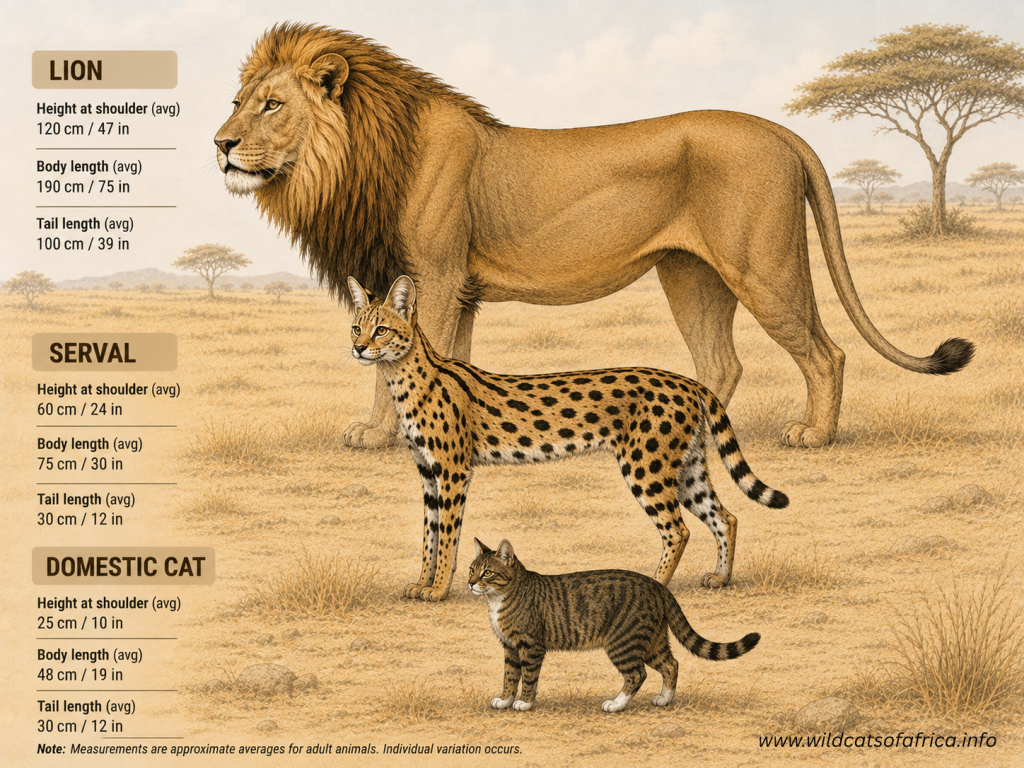
Serval Cat Size Comparison to Lion and Domestic Cat

A typical adult domestic cat (Felis catus) measures approximately:

Feature

Domestic cat

Serval

Head-body length

46-51 cm (18-20 in)

59-92 cm (23-36 in)

Shoulder height

23-25 cm (9-10 in)

54-66 cm (21-26 in)

Weight

3.5-5 kg (8-11 lb)

7-18 kg (15-40 lb)

The comparison illustrates that:

  • a serval weighs roughly two to four times as much as an average house cat;

  • it stands well over twice as tall at the shoulder;

  • its body is roughly 40-70% longer;

  • its legs create an especially dramatic difference in overall appearance.

Interestingly, the serval's body itself is not exceptionally long compared with similarly sized cats. Instead, much of its impressive height comes from its elongated lower limb bones.

Comparison with Africa's largest big cat - the Lion

Lions are much larger than a serval:

  • males commonly weigh 150-250 kg (330-550 lb)

  • shoulder height approaches 1.2 m (4 ft)

Yet despite being nearly twenty times heavier, lions have relatively:

  • shorter legs

  • shorter neck

  • much smaller ears in proportion to their bodies

The lion's anatomy emphasizes strength, stability and grappling with large prey rather than detecting small rodents hidden beneath grass.

Why These Proportions Matter

African Serval Wild Cat in Grassland
African Serval wild cat hunting in tall grassland by Jurgen Bierlein

The serval's unusual dimensions are not simply aesthetic—they are highly specialized evolutionary adaptations.

Its long legs increase visibility above grasslands while allowing powerful vertical leaps.

Its enormous ears detect rodents moving underground or beneath dense vegetation.

Its long neck enables precise downward strikes after locating prey by sound.

Together, these adaptations make the serval one of Africa's most efficient small-prey hunters, despite being only a medium-sized cat.

Rather than evolving greater body mass like a leopard or lion, the serval evolved height, hearing and reach. This combination occupies a unique ecological niche among the world's 40-plus living cat species and explains why no other felid shares quite the same silhouette.


Sources

Books

Peer-reviewed references

  • Caracal caracal (Carnivora: Felidae) (American Society of Mammalogists/Oxford Academic). (OUP Academic)

  • IUCN Red List species accounts for the serval, caracal and African golden cat (taxonomy and comparative biology).

Authoritative online references

  • International Society for Endangered Cats (ISEC Canada): African golden cat measurements and morphology. (ISEC)

Share this Page

Leave a Reply

Your email address will not be published. Required fields are marked *

This site uses Akismet to reduce spam. Learn how your comment data is processed.