Are Caracals Endangered? Status Varies from LC to CE over their Range
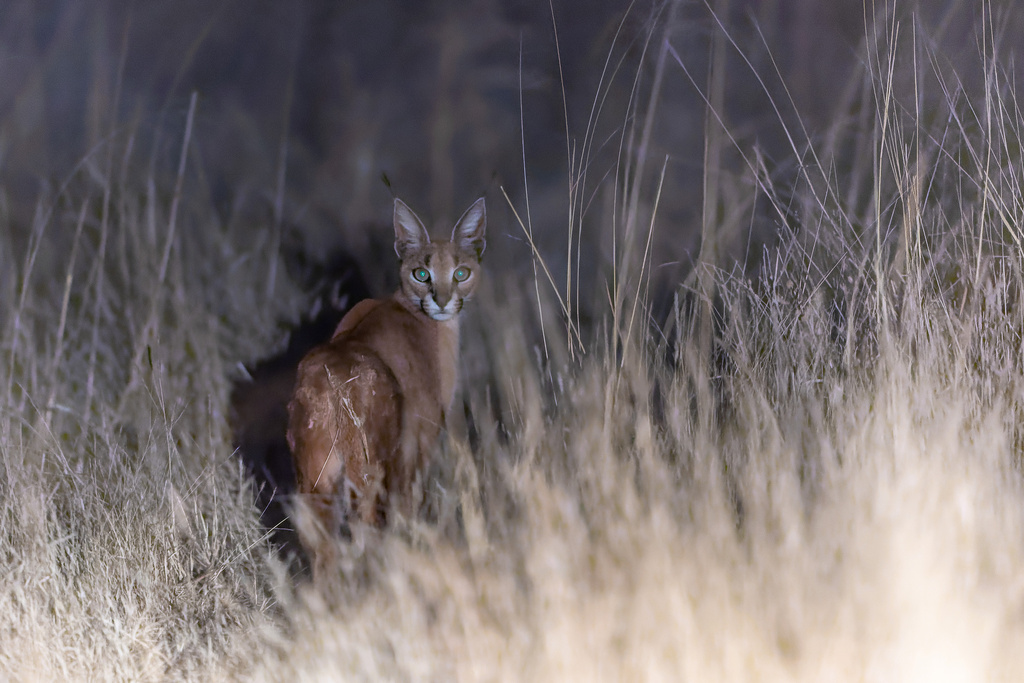
Globally the Caracal is listed as Least Concern (IUCN 2002–present) because of its broad distribution across both Africa and Asia and presumed large overall population. However, this masks serious regional declines.
For example, North African populations are nearly extinct in many countries, and Morocco’s caracals are considered critically endangered. In the Middle East the species is threatened: it is listed as Vulnerable or endangered in some countries. In South Asia the situation is dire – India’s caracals are estimated at only a few dozen animals (perhaps 50–100 cats) and critically endangered in that country. Pakistan’s tiny population (only ~100–150 individuals) is officially Critically Endangered. By contrast, in southern Africa caracals are still relatively common.
Common threats across the Caracal’s range include habitat loss (from agriculture, urbanization and road building) and direct killing by people. Farmers sometimes shoot caracals to protect livestock, and road mortality and illegal trade in Caracal parts have been reported in places like Iran and the Arabian Peninsula. In urbanizing areas of Cape Town, South African Caracals have even been found to suffer from rodenticide and metal pollutant exposure (studies found anti-coagulant poisons in their bodies).
Conservation measures vary: Caracals occur in many protected areas, and hunting is outlawed in most range countries. Although their global status remains Least Concern, many experts warn that without local protections, these cats could vanish from parts of their range.
ARTICLE STATUS: DRAFT - This article is currently being reviewed and fact checked.
D R A F T INFOGRAPHIC - Under Review - Corrections in Progress
Is the Caracal Endangered?
The Caracal is not endangered at the global level; however, it is endangered in several of its regional populations.
There is a continuum from common in the south of its African region to rare in its northern Asian region:
Southern Africa → relatively widespread and adaptable
↓
East/West/Central Africa → increasingly poorly documented
↓
North Africa/Middle East → localized and often declining
↓
Arabian Peninsula → some populations critically endangered
↓
South/Central Asia → highly fragmented, rare and poorly known
Here follows a summary per region and country showing the assessments that have been conducted on the conservation status of the Caracal.
Notes:
- There are many countries that may not have conducted conservation assessments on Caracals, or their reports are not publicly available.
- Not all countries use the same assessment process and may use different status terminology to the IUCN Red List.
Africa
North Africa
The Cat Specialist Group describes the caracal as threatened in North Africa and specifically identifies Morocco as Critically Endangered. It also describes the species as rare and patchily distributed in North Africa. A 2024 Algerian carnivore review found only 12 caracal records since 2017, compared with 48 historical records, and classified it as Near Threatened at the Mediterranean assessment level, although this is not a formal Algerian national Red List category.
Country | Assessment | Year | Source |
|---|---|---|---|
Algeria | Near Threatened at Mediterranean level | 2024 | |
Egypt | Not found | — | |
Libya | Not found | — | |
Morocco | Critically Endangered | — ? | |
Sudan | Not found | — | |
Tunisia | Not found | — |
Regional summary — North Africa: The caracal occurs in 6 countries. One recent country-specific study for Algeria was found, although it does not constitute a formal national Red List, and a Cat Specialist Group assessment identifying Morocco as Critically Endangered. The available evidence indicates that North African populations are substantially more threatened than the species' global Least Concern status suggests.
West Africa
The caracal's West African distribution is much less well documented. The Cat Specialist Group describes it as rare and patchily distributed in the savanna regions of West Africa, with habitat loss and hunting for skins and bushmeat identified as threats.
Country | Assessment | Year | Source |
|---|---|---|---|
Benin | Not found | — | |
Burkina Faso | Not found | — | |
Côte d'Ivoire | Not found | — | |
Gambia | Not found | — | |
Ghana | Not found | — | |
Guinea | Not found | — | |
Guinea-Bissau | Not found | — | |
Mali | Not found | — | |
Mauritania | Not found | — | |
Niger | Not found | — | |
Nigeria | Not found | — | |
Senegal | Not found | — | |
Togo | Not found | — |
Regional summary — West Africa: The caracal occurs in 13 countries, but no recent formal national Red List assessments for any of the 13 was found. The best available regional information indicates that the species is rare and patchily distributed, with hunting and habitat loss important threats. This is therefore a major geographic information gap rather than evidence that the species is secure.
Central Africa
The Cat Specialist Group identifies Central Africa as one of the regions where habitat destruction is a significant threat and describes caracals as rare and patchily distributed in Central African savannas.
Country | Assessment | Year | Source |
|---|---|---|---|
Angola | Not found | — | |
Cameroon | Not found | — | |
Central African Republic | Not found | — | |
Chad | Not found | — | |
Democratic Republic of the Congo | Not found | — | |
Gabon | Not found | — |
Regional summary — Central Africa: The caracal occurs in 6 countries, and no recent formal national Red List assessments were found for any of them. The available evidence suggests a sparse and poorly understood population, particularly in the savanna regions between the major tropical-forest blocks.
East Africa
This is a particularly interesting region because there is a mixture of reasonably good field information and considerable uncertainty over national population status.
Country | Assessment | Year | Source |
|---|---|---|---|
Djibouti | Not found | — | |
Eritrea | Not found | — | |
Ethiopia | Not found | — | |
Kenya | No formal national category located; population/trend poorly known | — | |
Malawi | Not found | — | |
Mozambique | Not found | — | |
Somalia | Not found | — | |
South Sudan | Least Concern in national State of Environment assessment | 2018 | |
Tanzania | Declining population reported in conservation planning literature | 2006 | |
Uganda | Data Deficient | 2018 | |
Zambia | Not found | — | |
Zimbabwe | Not found | — |
Regional summary — East Africa: Using the current country distribution, the caracal occurs in 12 countries. There is country-specific conservation information for Kenya, South Sudan, Tanzania and Uganda, but only South Sudan provides a national LC classification, and Uganda explicitly classifies the species as Data Deficient. Thus 8 of the 12 countries have no separate recent national assessment located. The region has generally good caracal occurrence records.
Southern Africa
This is by far the best documented African region and contains the important 2025 South African assessment. The 2025 assessment covered 336 mammal taxa in South Africa, Eswatini and Lesotho and was undertaken between 2023 and 2025 by more than 40 institutions and 164 experts.
Country | Assessment | Year | Source |
|---|---|---|---|
Botswana | Not found | — | |
Eswatini | Least Concern — regional assessment | 2025 | |
Lesotho | Least Concern — regional assessment | 2025 | |
Namibia | Least Concern | 2022 | |
South Africa | Least Concern | 2025 |
Regional summary — Southern Africa: The caracal occurs in 5 countries. Four have a recent formal assessment covering them: South Africa, Eswatini and Lesotho through the 2025 regional Red List, and Namibia through its 2022 Carnivore Red Data Book. All assess the caracal as Least Concern. Botswana has no separate recent national assessment located. This is the strongest evidence that the species remains relatively widespread and secure in southern Africa, although persecution and predator-control practices remain important conservation concerns.

Middle East and Arabian Peninsula
Here the contrast with southern Africa becomes much more pronounced.
The 2011 Arabian Peninsula regional assessment classified the caracal as Least Concern across Kuwait, Oman, Qatar, Saudi Arabia, UAE and Yemen, but subsequent national evidence—particularly from the UAE and Jordan—shows that the global/regional LC classification can conceal extremely small national populations.
Country / territory | Assessment | Year | Source |
|---|---|---|---|
Israel | Vulnerable, B,D1+2 | 2004 | |
Jordan | Critically Endangered, B1ab(i,ii,iii) | 2025 | |
Kuwait | Least Concern — Arabian Peninsula regional assessment | 2011 | |
Lebanon | Not found | — | |
Oman | Least Concern — Arabian Peninsula regional assessment; included in Oman National Red Data Book | 2011 | |
Palestine | Not found | — | |
Qatar | Least Concern — Arabian Peninsula regional assessment | 2011 | |
Saudi Arabia | Least Concern — Arabian Peninsula regional assessment | 2011 | |
Syria | Not found | — | |
United Arab Emirates | Critically Endangered, C2a(i) | 2018 | |
Yemen | Least Concern — Arabian Peninsula regional assessment | 2011 |
The UAE assessment is especially important. It estimated the national population at close to, but more likely below, 250 mature individuals, with no subpopulation exceeding 50 mature individuals and a continuing decline from persecution and habitat loss.
Jordan's 2025 assessment is even more alarming: it describes the species as very rare, with a sharply declining population and records suggesting that only five individuals may remain.
Regional summary — Middle East/Arabian Peninsula: The caracal occurs in approximately 11 countries/territories represented here. There are formal national assessments for Israel, Jordan and the UAE, plus the 2011 regional assessment covering six Arabian Peninsula states. National statuses range from Least Concern to Vulnerable and Critically Endangered. The most recent assessments are particularly concerning: Jordan (2025) and UAE (2018) are both Critically Endangered.
Asia
Asia has perhaps the greatest discrepancy between the global LC assessment and the actual status of local populations.
Country | Assessment | Year | Source |
|---|---|---|---|
Afghanistan | Not found | — | |
India | Near Threatened in historical CAMP assessment; now a major national conservation priority; Schedule I; national recovery programme | 1998–2026 | |
Iran | Threatened/declining | — | |
Iraq | Not found | — | |
Kazakhstan | Critically Endangered in national Red Data Book | 2010 | |
Pakistan | Critically Endangered; estimated 100–150 individuals | 2003 | |
Tajikistan | Not found | — | |
Turkey | Notfound | — | |
Turkmenistan | Endangered in national Red Data Book | 2011 | |
Uzbekistan | Critically Endangered in national Red Data Book | 2009 |
India
The Indian situation has changed considerably since the older assessments.
The 2025 Status of Small Cats in India report records the caracal in only Rajasthan, Gujarat and Madhya Pradesh, with estimates of roughly 10–15 individuals in the Kutch region of Gujarat and fewer than 50 in Rajasthan in the sources it reviewed. It also describes the species as one of India's rarest and most threatened wild cats.
Then, in August 2026, the Wildlife Institute of India published the first comprehensive national Conservation Action Plan for Caracal, Fishing Cat and Clouded Leopard, incorporating spatial analysis, threat assessment, priority landscapes, monitoring and management recommendations.
A 2026 field study from Rajasthan is also valuable: 5,258 camera-trap days at 177 locations produced 92 independent caracal photographs at 54 locations, demonstrating that populations can persist in human-dominated semi-arid landscapes.
Central Asia
A 2019 review of Uzbekistan's caracals states that the species is one of the rarest vertebrates in Central Asia and records the national Red Data Book classifications as:
Uzbekistan — Critically Endangered
Kazakhstan — Critically Endangered
Turkmenistan — Endangered
Regional summary — Asia: There is country-specific conservation information for 10 Asian range countries. At least four have particularly strong national threatened-status evidence: Kazakhstan CR, Uzbekistan CR, Turkmenistan EN and Pakistan CR. India has no equivalent current national Red List category, but its 2025 government assessment and 2026 national Conservation Action Plan clearly identify the caracal as a high conservation priority. Iran and Turkey are also described as declining/very rare by the Cat Specialist Group.
Summary of Caracal Conservation Status
The global IUCN assessment remains: Caracal — Least Concern (LC) but the Caracal conservation status varies considerably at regional and national levels.
Location | Status | Year |
|---|---|---|
South Africa | Least Concern | 2025 |
Namibia | Least Concern | 2022 |
Uganda | Data Deficient | 2018 |
Israel | Vulnerable | 2004 |
Morocco | Critically Endangered | current CatSG summary |
UAE | Critically Endangered | 2018 |
Jordan | Critically Endangered | 2025 |
Pakistan | Critically Endangered | 2003 |
Kazakhstan | Critically Endangered | 2010 |
Uzbekistan | Critically Endangered | 2009 |
Turkmenistan | Endangered | 2011 |
India | Major conservation priority / Schedule I | 2025–26 |
The IUCN/SSC Cat Specialist Group describes the species as very common and stable in southern Africa, but rare or poorly known across much of North Africa, Central Asia and India; it specifically identifies Pakistan as Critically Endangered and Iran as threatened and declining.
The other striking finding is the lack of national assessments. In West and Central Africa especially, the absence of national Red List assessments should be regarded as an information gap, not as evidence that populations are healthy as per the global status of Least Concern.
Full source list
Here are the full titles and bibliographic details of the principal sources used, in order of appearance in the article:
- Patel, T., Smith, C., Roxburgh, L., da Silva, J.M. & Raimondo, D. (eds.) (2025). The Red List of Mammals of South Africa, Eswatini and Lesotho. South African National Biodiversity Institute and Endangered Wildlife Trust.
- Drouilly, M., Serieys, L.E.K., Leighton, G.R.M. & da Silva, J.M. (2025). "A conservation assessment of Caracal caracal." In The Red List of Mammals of South Africa, Eswatini and Lesotho.
- Pallett, J., Thomson, G. & Jarvis, A. (eds.) (2022). Conservation Status and Red List of the Terrestrial Carnivores of Namibia. Ministry of Environment, Forestry and Tourism; Large Carnivore Management Association of Namibia; Namibian Chamber of Environment, Windhoek.
- Luyt, C. & Fleury, G. (2022). "A conservation assessment of Caracal Caracal caracal." In Conservation Status and Red List of the Terrestrial Carnivores of Namibia, pp. 54–57.
- Dolev, A. & Perevolotsky, A. (2004). The Red Book: Vertebrates in Israel. Israel Nature and Parks Authority and Society for the Protection of Nature in Israel, Jerusalem.
- Mallon, D. & Budd, K. (eds.) (2011). Regional Red List Status of Carnivores in the Arabian Peninsula. IUCN, Cambridge/Gland, and Environment and Protected Areas Authority, Sharjah.
- Mallon, D., Hilton-Taylor, C., Allen, D. & Harding, K. (2019). UAE National Red List of Mammals: Marine and Terrestrial. Report to the Ministry of Climate Change and Environment, UAE. IUCN Global Species Programme.
- National Red Data Book of Jordan (2025), species account for Caracal caracal. IUCN Regional Office/partners. Critically Endangered B1ab(i,ii,iii).
- Wildlife Institute of India (2026). Lyngdoh, S., Bhatt, U., Goyal, S.P. & Habib, B. Conservation Action Plan for Caracal, Fishing Cat, and Clouded Leopard. Technical Report, WII, Dehradun, 220 pp.
- National Tiger Conservation Authority (2025). Status of Small Cats in India.
- IUCN/SSC Cat Specialist Group (current 2026 species account). Living Species – Caracal (Caracal caracal).
- Veals, A.M., Burnett, A.D., Morandini, M., Drouilly, M. & Koprowski, J.L. (2020). "Caracal caracal (Carnivora: Felidae)." Mammalian Species 52(993): 71–85.
- Moqanaki, E.M. et al. (2016). "The caracal in Iran – current state of knowledge and priorities for conservation."
- Gritsina, M.A. (2019). "The Caracal Caracal caracal Schreber, 1776 (Mammalia: Carnivora: Felidae) in Uzbekistan." Journal of Threatened Taxa 11(4): 13470–13477.
- IUCN Pakistan / Zoo Outreach Organisation (2003). Status and Red List of Pakistan's Mammals – CAMP Review.
- Eid, E., Soultan, A. & Elalqamy, H. (2022). "Habitat Suitability Modelling for Feline Species in Jordan: A tool for Climate-Responsive Conservation Planning." Journal of Wildlife and Biodiversity.
- 2024 Algerian carnivore assessment: "New Data on the Chronological and Chorological Composition, Structure, Distribution, and Biology of the Conservation of Algerian Carnivora (Mammalia)."
- South Sudan Government/UNEP (2018). South Sudan State of Environment Report.
- Wildlife Institute of India / Journal of Threatened Taxa (2026). Mairaj, M., Jain, D., Bhakar, R. & Sadhu, A. "Distribution, habitat use, and abundance of the Caracal Caracal caracal in a semi-arid Indian landscape." Journal of Threatened Taxa 18(5): 28770–28783.
AI Disclosure: This article and infographic were drafted with AI assistance and reviewed by Mandy before publication.